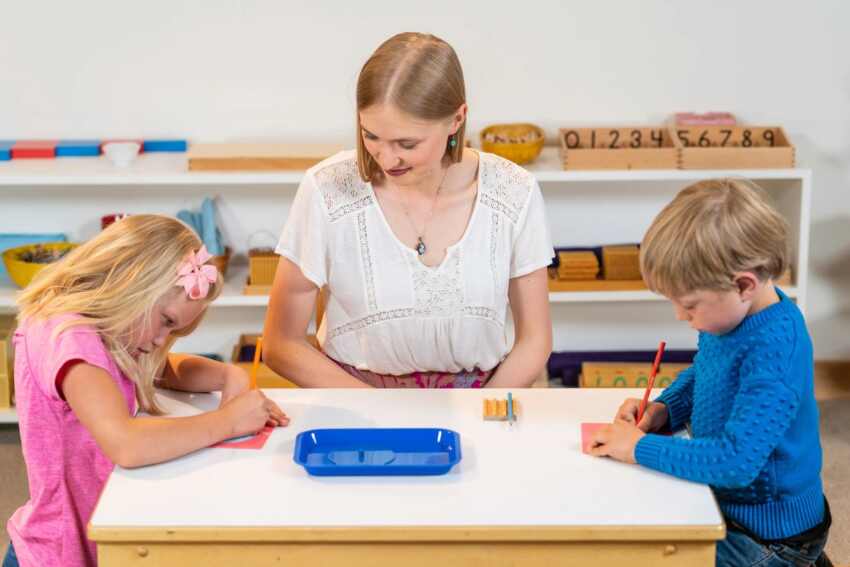

In an era where STEM education dominates educational discourse, Montessori schools are often overlooked, yet they have been delivering authentic STEM learning for over a century — without screens or worksheets. Montessori STEM education is not a separate subject; it is woven into every corner of the prepared environment. The child who builds the Pink Tower is learning geometry and spatial reasoning. The child who sorts leaves by vein pattern is doing biology classification. The child who measures water volume with golden beads is exploring measurement and base-ten mathematics. The difference is that Montessori presents these concepts concretely, through hands-on learning benefits that engage the senses and build intuitive understanding before abstract symbols are introduced.
Research on early childhood brain development confirms that young children learn best through direct manipulation of objects, not through lectures or digital simulations. The Montessori classroom is a laboratory where children experiment with real materials, make predictions, test outcomes, and refine their theories. This is the essence of scientific inquiry skills. When a child wonders why some objects sink and others float, the teacher does not provide an answer; she provides a bowl of water and a collection of objects. The child discovers buoyancy through repeated trial and error, building neural pathways that make future physics concepts feel familiar rather than foreign. This approach produces children who think like scientists: curious, methodical, and unafraid of being wrong.
Building Mathematical Thinking Through Concrete Manipulatives
The foundation of Montessori STEM is mathematics, taught through a sequence of materials that progress from concrete to abstract. The Number Rods, Sandpaper Numerals, Spindle Box, and Golden Beads are not just counting tools; they are introductions to number theory, place value, and operations. A child using the Golden Beads to add 2478 + 3539 is not memorizing an algorithm; she is exchanging ten unit beads for a ten-bar, ten ten-bars for a hundred-square, and ten hundred-squares for a thousand-cube. She sees and feels that 10 units equal one ten, that 10 tens equal one hundred, and so on. This embodied understanding of the decimal system means that when she later learns abstract addition with carrying, the algorithm makes perfect sense — she has lived it.
Beyond basic arithmetic, Montessori materials introduce squaring, cubing, and square roots through the bead chains and the binomial and trinomial cubes. The binomial cube, a wooden puzzle that visually represents (a+b)³, is given to four-year-olds as a sensorial puzzle. They build it by matching colors and sizes, not knowing the algebra. But when they encounter the formula in middle school, their brains already have a spatial model to attach it to. This is the power of experiential learning methods: the child internalizes concepts long before they are named. Studies on mathematical thinking development show that students who learn with manipulatives have greater flexibility and transfer than those who learn symbolically, because they understand why procedures work, not just how to execute them.
Furthermore, Montessori mathematics encourages problem-solving skills in children by presenting open-ended challenges. The teacher might say, “Show me all the ways to make ten using the bead bars.” The child experiments with 9+1, 8+2, 7+3, 5+5, and discovers combinations independently. This inquiry-based learning approach fosters a growth mindset education because there is no single right answer — only a process of discovery. The child who struggles is encouraged to use materials again, not shamed for slowness. This builds resilience and adaptability, key components of future-ready skills for children. In a Montessori math classroom, the focus is never speed or memorization; it is deep, joyful understanding.
Scientific Inquiry Skills Through Sensorial and Nature Materials
The Sensorial area of the Montessori classroom is, in essence, a scientific apparatus. The Knobbed Cylinders require the child to discriminate depth and diameter — the same skills a scientist uses to measure and compare. The Color Tablets refine visual discrimination to a high degree, preparing the child for colorimetry in chemistry. The Baric Tablets (weight discrimination) and Thermic Tablets (temperature discrimination) develop the ability to perceive subtle differences that underlie precise observation. Maria Montessori designed these materials to be “materialized abstractions” — physical embodiments of scientific concepts. When a child grades the Sound Boxes from loudest to softest, they are learning the concept of a continuous variable, a cornerstone of scientific measurement.
Beyond the classroom, Montessori science education extends into the outdoor environment and through nature education activities. Children study living things by caring for classroom plants and animals, observing life cycles, and maintaining terrariums. They learn botany through leaf classification and gardening, zoology through animal puzzle maps and research projects, and earth science through weather observation and rock collections. These activities are not once-a-week specials; they are daily choices available to children during the three-hour work cycle. A child fascinated by insects might spend weeks observing ants, drawing them, reading about them, and writing a little book. This self-directed project-based learning is the heart of personalized learning strategies and builds the kind of deep knowledge that standardized tests cannot measure.
The Montessori approach to science also emphasizes the scientific method implicitly. When a child asks, “Why does that plant grow toward the window?” the teacher might respond, “What do you think? How could we find out?” The child then designs an experiment: put one plant in the window, one in a dark closet, and observe. This simple experiment teaches hypothesis formation, controlled variables, data collection, and conclusion drawing — all without a textbook. This experiential learning method produces children who approach the world with a scientist’s mindset: curious, skeptical, and evidence-driven. These are precisely the critical thinking skills needed to navigate a world of misinformation and complex challenges.
Technology Integration and Robotics in the Montessori Elementary Classroom
While Montessori primary classrooms (ages 3-6) focus on concrete, screen-free materials, elementary classrooms often incorporate technology in thoughtful, purposeful ways. Montessori technology integration emphasizes the computer as a tool, not a toy. Children learn keyboarding for writing research reports, use spreadsheets to organize data from experiments, and explore coding through tactile robotics like Bee-Bots or LEGO WeDo before moving to screen-based languages. This aligns with Montessori’s principle of moving from concrete to abstract: the child first programs a physical robot to move forward and turn, seeing cause and effect directly, before learning about variables and loops in a simulated environment.
Montessori robotics for children is not about competitive leagues or trophies; it is about understanding how machines work and how humans can direct them. The child who builds a simple robot that waters a plant when a moisture sensor triggers is engaging in systems thinking, engineering design, and problem-solving. They learn that technology is not magic but a set of logical steps. This demystifies computers and empowers children to see themselves as creators, not just consumers. Moreover, robotics naturally fosters collaboration and teamwork skills, as building and programming a robot is rarely a solo endeavor. Children must negotiate roles, share ideas, and debug code together — all while practicing conflict resolution skills when their approaches differ.
Importantly, Montessori technology integration never replaces hands-on, sensory-rich learning. The child still builds with wood, gardens in soil, and mixes baking soda and vinegar in a bowl. Technology is introduced as another tool in the prepared environment, appropriate to the child’s developmental stage. Research on educational technology integration shows that screen time is most beneficial when it is active, creative, and social — exactly the conditions Montessori advocates. By the time Montessori children reach middle school, they have a solid foundation in scientific inquiry, mathematical thinking, and technological literacy that allows them to excel in advanced STEM subjects. More importantly, they have retained their natural curiosity and love of learning, which is the true goal of education.