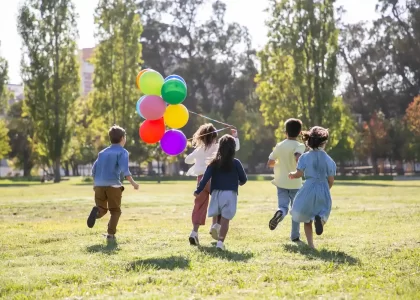
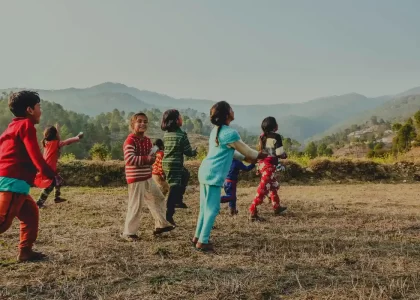
When a child steps outside the Montessori classroom into a garden or natural play space, the learning does not stop — it transforms. Montessori outdoor learning is not merely recess; it is an extension of the prepared environment, designed to engage the whole child through nature-based learning benefits that no indoor material can replicate. Research in early childhood brain development shows that exposure to natural settings reduces stress hormones, increases attention span, and enhances cognitive flexibility. The outdoor classroom offers open-ended materials — sticks, stones, leaves, water, mud — that invite exploration, creativity, and scientific thinking. Unlike plastic toys with fixed functions, nature’s loose parts adapt to the child’s imagination, building problem-solving skills in children as they figure out how to build a dam in a stream or balance a log on a rock.
Maria Montessori herself emphasized the importance of connecting children with nature, writing that the child should be “left free to encounter nature” and to experience its wonders directly. Modern environmental awareness education has validated this insight: children who spend regular time outdoors develop stronger ecological literacy, empathy for living things, and a sense of global citizenship. The Montessori outdoor curriculum includes gardening, animal care, nature walks, weather observation, and outdoor practical life activities like sweeping leaves or watering plants. These experiences build fine motor skills through digging and gross motor skills through climbing and running, all while fostering a growth mindset education as children learn that seeds take time to grow and that nature follows its own timeline, not the child’s.
How Gardening Programs Cultivate Responsibility and Scientific Inquiry
In a Montessori gardening program, each child may be responsible for planting a seed, watering it daily, and recording its growth. This simple act is a masterclass in character education and executive function development. The child learns delayed gratification — the seed does not sprout overnight — and cause-and-effect: too much water kills the plant, too little makes it wilt. These are not abstract lessons; they are lived experiences that build resilience and adaptability. When a child’s plant fails to thrive, the teacher does not replace it immediately; instead, they guide the child to observe, hypothesize, and try again. This inquiry-based learning approach mirrors the scientific method and teaches that failure is a step toward understanding, not a final judgment.
Gardening also provides rich opportunities for language development and literacy development insights. Children learn the names of plants, insects, and tools, expanding vocabulary far beyond typical classroom lists. They write in garden journals, draw what they see, and read seed packets. The garden becomes a living textbook for mathematical thinking development as children measure plant height, count seeds, and calculate days until harvest. One study on STEM learning foundations found that children who participated in school gardening scored significantly higher on science achievement tests than peers who did not, because the garden made concepts like photosynthesis, life cycles, and ecosystems tangible. In Montessori, the garden is not an add-on; it is a core component of cultural education and environmental awareness.
Beyond academics, gardening supports social-emotional learning in profound ways. Children must collaborate to prepare soil, share tools, and decide where to plant. Conflicts arise — who gets to water today? — and are resolved using grace and courtesy lessons. The garden also teaches interdependence: the child learns that earthworms are helpers, that bees are essential for pollination, and that every creature has a role. This fosters emotional intelligence development by expanding the child’s circle of empathy beyond humans to all living beings. In a time of climate crisis, Montessori gardening programs produce children who feel connected to the earth and motivated to protect it, embodying the values of sustainability education and global citizenship.
Nature Walks and the Development of Sensory Learning
Montessori nature walks are not casual strolls; they are guided sensory explorations that build attention and concentration building through focused observation. Before the walk, the teacher might give each child a small basket and a mission: find five different shades of green, or collect three types of leaves with smooth edges, or listen for three distinct bird calls. These tasks turn a simple walk into a sensory learning and development exercise that sharpens visual, auditory, and tactile discrimination. The child who must distinguish between oak and maple leaves is practicing the same classification skills used later in botany and biology. The child who closes their eyes to identify bird songs is building auditory memory that supports phonemic awareness in reading.
Nature walks also directly support physical development. Climbing over logs, balancing on stones, and walking on uneven terrain build gross motor skills and proprioception — the body’s sense of its position in space. These movements activate the vestibular system, which is linked to attention and emotional regulation. Research on fine motor skill development shows that outdoor play that involves picking up small objects (acorns, pebbles) strengthens the pincer grip just as effectively as indoor manipulatives. Moreover, exposure to natural light and fresh air regulates circadian rhythms and boosts vitamin D, both critical for early childhood brain development. Children who spend time outdoors have lower rates of myopia, less anxiety, and better sleep patterns — all of which enhance cognitive development in young learners.
The nature walk also builds language acquisition strategies through direct experience. The teacher models descriptive language: “This bark is rough and furrowed. This leaf is smooth and waxy. The moss feels spongy and damp.” Children internalize these adjectives and later use them in their own writing and speech. The walk also fosters creative thinking enhancement as children imagine stories about the hollow tree or the path of a beetle. Unlike indoor environments that can become predictable, nature is ever-changing — a puddle after rain, a fallen nest, a new mushroom — which keeps curiosity alive and fuels lifelong learning habits. The Montessori child who learns to love nature walks grows into an adult who seeks nature for restoration and wonder.
Outdoor Practical Life and Risk-Taking for Resilience
Montessori outdoor environments include practical life activities adapted for nature: washing vegetables from the garden, sweeping the patio, carrying water buckets, and building shelters with branches. These activities require strength, coordination, and judgment. When a child carries a heavy bucket of water across an uneven lawn, they must constantly adjust their gait and grip — an excellent exercise in self-regulation and self-control. When they build a stick shelter that collapses, they learn to analyze why and try a different structure. These experiences build problem-solving skills in children far more effectively than any indoor puzzle because the consequences are real and immediate.
Importantly, Montessori outdoor learning embraces calculated risk-taking. Children climb trees, use real tools (child-sized shovels and pruning shears), and navigate natural obstacles. This runs counter to the overprotective trends in modern education, but research on resilience and adaptability building shows that children who are allowed to take age-appropriate risks develop better risk assessment, confidence, and physical competence. The Montessori teacher supervises closely but does not interfere unnecessarily. When a child climbs a low tree branch and hesitates, the teacher may ask, “Do you feel stable? What is your plan to get down?” rather than lifting them down immediately. This scaffolds decision-making skills and builds self-esteem from real achievement, not empty praise.
Finally, outdoor learning naturally incorporates peace education. The quiet of nature, the sound of wind in leaves, the sight of clouds moving — these experiences calm the nervous system and foster mindfulness practices. Many Montessori schools begin the day with outdoor silent reflection or a walking meditation. Children learn to sit still and observe, a skill that transfers to indoor concentration. The outdoor classroom also teaches respect for all life: children learn to step around ant trails, to return rocks to their places, and to leave flowers for others to enjoy. These small acts of care build character education and a sense of being part of something larger than oneself. In a world increasingly disconnected from nature, Montessori outdoor learning is not a luxury; it is a necessity for raising children who are healthy, curious, and compassionate stewards of the earth.