
In many classrooms, art means following a template: color inside the lines, glue pre-cut shapes onto paper, or copy the teacher’s example. Montessori art education could not be more different. The art shelf is open all day, stocked with high-quality materials: watercolor paints, modeling clay, pastels, collage supplies, and real scissors. Children choose what to create, when to create it, and how long to spend. There are no prescribed projects, no “take-home crafts,” and no competition. The goal is not a product to hang on the wall; the goal is the process — the development of creative thinking, fine motor control, and emotional expression. Montessori understood that art is a language of the soul, and children need the freedom to speak it without adult interference.
Research on arts-based learning benefits shows that open-ended art making supports cognitive development in young learners by strengthening divergent thinking, problem-solving, and visual-spatial skills. When a child mixes red and yellow paint and discovers orange, they are doing chemistry and color theory. When they tear paper for a collage, they are building hand strength and bilateral coordination. When they model a clay figure that keeps collapsing, they are learning physics and persistence. Unlike craft projects that follow a recipe, open-ended art requires the child to make hundreds of decisions: what color, what shape, what size, what composition. These decisions build decision-making skills and self-regulation because the child must commit to a choice and live with the consequences.
The Metal Insets: Preparing the Hand for Writing Through Art
One of the most important art materials in the Montessori classroom is often overlooked: the Metal Insets. These are ten geometric shapes (square, circle, triangle, etc.) made of metal with a frame and a removable inset. The child traces the frame with a colored pencil, then fills the shape with parallel lines in a different color. This exercise is art, but it is also a precise preparation for handwriting. The child learns to control a pencil, to stay within boundaries, and to maintain consistent line direction — all skills needed for legible writing. Yet because it is presented as art, children practice for hours without complaint, building fine motor skills and concentration without the stress of letter formation.
Beyond handwriting preparation, the Metal Insets teach geometry. The child traces the square, the triangle, the curvilinear shapes, internalizing their properties through the hand. Later, when the teacher introduces the geometric cabinet and nomenclature cards, the child already knows the shapes viscerally. This integration of art and academics is characteristic of Montessori’s holistic approach. The child is not forced to choose between art and math; art is math, and math is art. When a child fills a circle with parallel lines at varying angles, they are exploring pattern, repetition, and visual rhythm — concepts that underlie both artistic composition and mathematical sequences.
The Metal Insets also support emotional development. The repetitive, rhythmic motion of tracing and filling is calming, similar to the effect of coloring mandalas in adult mindfulness practices. Children often choose the Metal Insets when they feel dysregulated, using the structured activity to regain self-control. This is a form of self-regulation and self-control that the child learns independently, without teacher intervention. The beautiful, orderly results also build self-esteem; the child sees that they have created something precise and pleasing, which reinforces their sense of competence. In this way, Montessori art education serves both the hand and the heart, preparing the child for academic success and emotional well-being simultaneously.
Open-Ended Art Materials and Creative Thinking Enhancement
The Montessori art shelf is stocked with real, high-quality materials: Prismacolor pencils, watercolor paper, natural clay, and fabric scraps. There are no coloring books or pre-stamped shapes. This is deliberate. Research on creative thinking enhancement shows that open-ended materials with no prescribed outcome produce higher levels of creativity than kits or templates. When a child is given a blank sheet of paper and a set of pastels, they must generate the idea themselves. This is hard work for the brain, but it builds the neural pathways of creativity. In contrast, a coloring page asks only for motor control, not invention. Montessori teachers resist the urge to display “cute” crafts made from adult-designed templates, knowing that real creativity is messy, unpredictable, and often not photogenic.
Children in Montessori classrooms learn to respect art materials. They are shown how to wash brushes, how to replace caps on glue bottles, and how to roll up their art mat when finished. This care of materials is part of the practical life curriculum and teaches responsibility and respect. When a child spills paint, they get a sponge and clean it up. This autonomy builds independence and self-regulation. Moreover, because materials are always available, children can return to a work over multiple days, developing persistence and the ability to revise. A child might paint a horse, decide it looks like a dog, and paint over it — this is the creative process in action, and it builds resilience and adaptability far better than a one-session craft.
Montessori art education also includes art appreciation. The classroom displays high-quality prints of masterworks at the child’s eye level. Children learn the names of artists and movements through three-period lessons and matching games. They might be invited to “paint like Monet” using watercolors and soft brushstrokes, but it is an invitation, not a requirement. This exposure builds cultural awareness and global citizenship, as children learn about art from different times and places. They also learn that art is not just self-expression but also communication, history, and beauty. In an era of digital filters and instant gratification, Montessori art education teaches children to slow down, to look closely, and to value the process of making something by hand.
Music, Dance, and Movement as Artistic Expression
While visual art is prominent, Montessori also values music, dance, and movement education. The classroom has a set of bells that produce the chromatic scale; children learn to match tones, arrange bells in order, and eventually play simple melodies. This is not performance training but ear training that builds auditory discrimination — the same skill needed for phonemic awareness in reading. Children also learn rhythm through clapping games, percussion instruments, and movement activities. Music and movement are integrated into the daily rhythm: walking on the line to music, singing during transitions, and dancing during group time. This integration of arts-based learning benefits with academic readiness is seamless and natural.
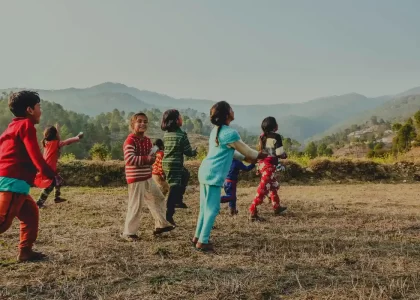
Dance and movement in Montessori are not about recital choreography; they are about creative expression and body awareness. Children are given scarves, ribbons, and space to move freely to different types of music. They learn to control their bodies, to move fast and slow, high and low, alone and with a partner. This supports gross motor skill development, spatial awareness, and social-emotional learning as children negotiate shared space. A simple activity like “mirror dancing” (one child leads, another follows) builds empathy, attention, and collaboration and teamwork skills without any verbal instruction. These movement experiences are also grounding for children who struggle with sitting still; the classroom recognizes that movement is a legitimate way of learning and expressing oneself.
Finally, Montessori art education celebrates the child’s unique voice. There are no grades in art, no competitions, no “best” drawings. Every child’s work is valued equally because the process is what matters. This fosters a growth mindset education where children learn that artistic ability is not fixed but grows with practice. Children who feel safe to create without judgment are more likely to take risks, experiment, and persist through frustration — skills that transfer to every academic subject. In a world that increasingly values standardized testing and measurable outcomes, Montessori art education stands as a reminder that the true purpose of education is to nurture the whole child: the thinking mind, the feeling heart, and the creating hand.