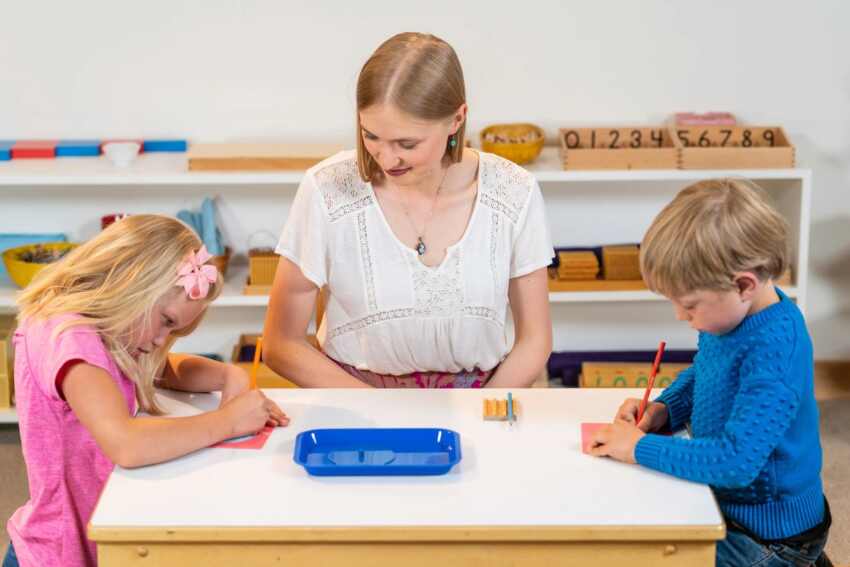
Creativity is often misunderstood as the ability to make something out of nothing, but in the Montessori context, it is viewed as the ability to create new connections and meanings from existing knowledge. It is an intellectual and spiritual force that is nurtured through the interaction between the child and their environment. While Montessori materials are often precise and structured, there is a profound space for open-ended exploration and creative expression within the curriculum. This balance between structure and freedom is essential for fostering Creative Thinking Enhancement. The environment is prepared with materials that allow for divergent thinking—problems that have multiple solutions and activities that can be extended in infinite directions. Unlike the reliance on fantasy in early childhood, Montessori creativity is grounded in reality. It is the child using their imagination to construct a tower, to paint a picture of a flower they observed, or to act out a story from history. This “work of the imagination” is fueled by the child’s real experiences and the rich sensorial input they have absorbed. By grounding creativity in reality, Montessori education gives the child a solid platform from which to launch their imaginative flights, ensuring that their creations are meaningful and connected to the world.
The Process Over the Product
In many traditional educational settings, art and creative activities are often product-oriented, where every child is expected to produce a similar result, such as a coloring page where the goal is to stay within the lines. Montessori education, however, places the emphasis firmly on the process. The art shelf in a Montessori classroom is filled with supplies for the child to use freely—clay, paints, pastels, collage materials—but there are no templates or models to copy. The child is invited to explore the medium, to experiment with color and texture, and to express their inner vision. This freedom supports Emotional Intelligence Development by providing a safe outlet for feelings and thoughts that the child may not yet have the words to express. When a child paints a chaotic swirl of dark colors, they are processing an emotion; when they carefully cut and paste paper to make a collage, they are refining their Fine Motor Skill Development and spatial reasoning. The value of the activity lies in the act of creation itself, not in the final object. This approach builds Confidence and Self-Esteem Development because the child’s work is a true reflection of themselves, validated by the joy of the process rather than external judgment or comparison to a standard. It teaches the child that their unique perspective has value and that they are capable of bringing something new into the world.
Fostering Imagination Through Reality
Dr. Montessori believed that the imagination is built upon the fruits of the intelligence. Before a child can imagine a fantastical world, they must understand the laws of the real world. The Montessori curriculum feeds the imagination with a banquet of real knowledge. The child learns about the structure of the universe, the diversity of life on earth, the rise of civilizations, and the beauty of art and music. This reservoir of knowledge provides the raw materials for the imagination. A child who has studied the planets can imagine a journey to Mars; a child who has learned about the Middle Ages can imagine life as a knight. This is Learning Through Play at its most sophisticated level. The child does not need to be told to pretend; the knowledge itself ignites the imagination. This is particularly evident in the elementary “Going Out” trips, where children plan excursions to museums, libraries, or businesses. These ventures require a high degree of Creativity Development and Problem-Solving Skills, as they must navigate the real world to satisfy their curiosity. By grounding imagination in a rich understanding of reality, Montessori education ensures that the child’s creative potential is boundless and rooted in truth.
Art as a Language of Expression
Art in the Montessori classroom is integrated into all areas of the curriculum. It is not a separate subject reserved for Friday afternoons but a continuous language of expression that runs through geography, history, science, and language. A child studying the biomes of Africa might paint the colors of the savanna; a child studying the geometry of a triangle might create an intricate geometric design using the metal insets. This integration demonstrates the Arts-Based Learning Benefits, reinforcing academic concepts through artistic expression. Furthermore, the freedom to choose one’s work extends to creative activities. A child may choose to write and illustrate a story, to sew a puppet, or to compose a song on the bells. This autonomy is crucial for maintaining the child’s engagement and fostering a lifelong love of learning. It allows the child to follow their own interests and to develop their unique talents. In an environment where creativity is respected and nurtured, children learn to take risks, to experiment, and to view mistakes as stepping stones to innovation. They develop the resilience and adaptability necessary to thrive in a rapidly changing world, proving that creativity is not just a talent but a habit of mind that can be cultivated through careful guidance and a prepared environment.