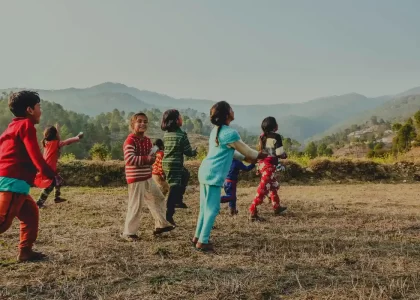
Maria Montessori identified the **Sensitive Period for Movement** as crucial in the early years, recognizing the child’s innate drive to move, which guides their psychophysical construction. The **Maasai Adumu** (jumping dance), a celebrated cultural tradition from East Africa, is a powerful, high-energy exercise that directly taps into this intense need for gross motor activity and controlled, vertical movement. For an international Montessori program, the Adumu offers a perfect cultural parallel to the need for challenging, purposeful **gross motor development**.
Jumping as a Tool for Proprioception and Willpower
The Adumu, performed primarily by young men, involves competitors taking turns jumping vertically high from a standing position, maintaining a narrow, rigid body posture. The primary goal is height, achieved through sheer muscular effort and control, a powerful demonstration of **Willpower** and physical discipline:
- Vertical Proprioception: The act of repeated, vertical jumping is an intense exercise in **proprioception**—the sense of one’s body in space. It strengthens the core, legs, and overall body awareness. In the Montessori context, mastering one’s ability to jump with control, land quietly, and resist the impact without losing balance directly aids in overall motor coordination and is a natural extension of balancing exercises like walking on the line.
- Channeling Energy: The Adumu is a structured way to channel the seemingly boundless, and often disruptive, **gross motor energy** of the young child. By providing a cultural, purposeful avenue for high-impact activity, the dance helps the child satisfy their innate need for vigorous movement, which, when satiated, often leads to greater calmness and focus during quieter, intellectual work. The external challenge serves the internal need for self-mastery.
- Rhythmic Synchronization and Community: Although the jumping is individual, the rhythmic structure and the collective presence of the group provide a strong sense of **community** and shared culture. The jumpers maintain a consistent rhythm with their landings and the accompanying song, reinforcing auditory memory and the importance of group cadence—a social skill crucial for the multi-age **International Montessori** classroom.
Introducing the principles of the Adumu—such as standing tall, jumping straight, and landing softly—as a brief, vigorous outdoor or indoor movement exercise can be incredibly beneficial. It honors the rich, dynamic traditions of the Maasai people, linking culture to physical education. This type of high-demand, self-directed physical exercise is essential, according to Montessori, for anchoring the child’s physical and mental capacities. By providing a cultural context for this intense physical work, the international school confirms the universality of human developmental needs and the power of purposeful, challenging movement to create a focused, capable individual.