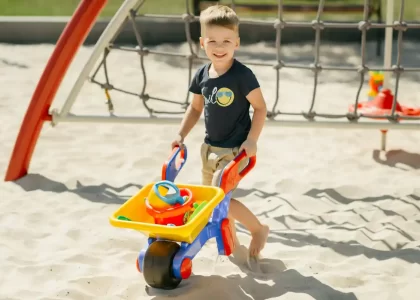

Maria Montessori recognized that the outdoor environment is not merely a recess space but a natural extension of the classroom. In fact, she called for the creation of “Giardini delle Bambine” (children’s gardens) and emphasized that contact with nature is essential for physical, cognitive, and emotional development. Modern Montessori outdoor learning takes this vision further, integrating nature education into daily curriculum through gardening, nature walks, outdoor practical life, and ecological studies. When children regularly engage with the natural world, they develop not only scientific observation skills but also environmental awareness and global citizenship. Research increasingly confirms what Montessori knew intuitively: time in nature reduces stress, improves attention and concentration building, and fosters resilience and adaptability building. Moreover, outdoor learning naturally incorporates hands-on learning benefits, from digging soil to identifying insects to measuring rainfall. By anchoring academic concepts in living, changing systems, Montessori outdoor education cultivates a sense of wonder and stewardship that no indoor lesson can replicate.
Gardening Programs: Integrating Biology, Responsibility, and Nutrition Education
The heart of Montessori outdoor learning is often a children’s garden. Each child or small group takes responsibility for a plot: preparing soil, planting seeds, watering, weeding, and harvesting. This sustained engagement teaches biology in the most concrete way possible. Children observe seed germination, plant growth, flowering, pollination, and seed formation. They learn to identify edible plants and understand where food comes from, directly supporting nutrition education. The garden also teaches practical life skills like using tools safely, planning work sequences, and collaborating with peers. When a child forgets to water his plot and the plants wilt, he experiences a natural consequence that builds responsibility and executive function development far more effectively than any lecture. Harvesting and preparing food — from pulling carrots to washing lettuce to cooking soup — creates authentic opportunities for practical life activities and instills healthy eating habits. Furthermore, gardening programs naturally incorporate measurement (how many centimeters have the beans grown?), data recording (weather observations), and ecology (composting, beneficial insects). Children learn about life cycles, interdependence, and the importance of biodiversity. These experiences build environmental awareness education and lay the foundation for later scientific inquiry skills. The garden also serves as a peaceful, restorative space for children who need a break from social stimulation, supporting emotional intelligence development and self-regulation and self-control.
Nature-Based Learning for Sensory Development and Scientific Observation
Beyond gardening, Montessori outdoor learning includes unstructured nature exploration. Children collect leaves, rocks, feathers, and seeds, bringing them inside for classification and study. They lie on the ground to watch clouds, listen for bird calls, and feel the temperature of sun and shade. These activities refine sensory perception and develop the stereognostic sense (knowing objects by touch). Nature journals encourage observational drawing and written descriptions, integrating literacy development and art education. A child who draws a maple leaf over several weeks will notice its changing colors, the vein patterns, and the texture of its stem. This close observation builds critical thinking skills and scientific habits of mind. Teachers guide children to ask questions: “Why do earthworms come out when it rains?” “How do spiders build their webs?” “What happens to puddles on sunny days?” These inquiries lead to simple experiments, such as placing a stick to mark a puddle’s edge and checking it hourly. Such activities embody inquiry-based learning approaches and experiential learning methods. The outdoors also naturally lends itself to gross motor skill development: running, climbing, balancing on logs, digging, carrying buckets. These movements strengthen core muscles, coordination, and proprioception, which are essential for fine motor control and classroom concentration. Unlike playground equipment with fixed purposes, natural landscapes offer infinite opportunities for creative thinking enhancement and problem-solving skills in children.
Environmental Stewardship and Global Citizenship Through Outdoor Projects
Montessori outdoor learning extends beyond the schoolyard to the local community and the planet. Older children participate in environmental projects: creek cleanups, tree planting, recycling programs, energy audits, and wildlife habitat restoration. These projects teach systems thinking: how individual actions affect ecosystems, communities, and future generations. Children learn about water cycles, carbon footprints, and sustainable agriculture in contexts that feel relevant and urgent. This education naturally leads to discussions of global citizenship and peace education, as environmental justice is intimately connected to human rights and intergenerational responsibility. Montessori schools often adopt a whole-school sustainability framework, including composting food waste, reducing single-use plastics, using rainwater for gardens, and sourcing local food for lunches. Children participate in decision-making and leadership roles, building leadership skills for children and collaboration and teamwork skills. They write letters to local officials, create educational posters, and present research to parents. These authentic projects develop communication skills development and confidence and self-esteem development. Furthermore, outdoor learning provides direct experiences of the sublime beauty of nature, which Montessori believed was essential for spiritual and moral development. A child who has watched a sunrise, felt moss, and heard a waterfall will be more inclined to protect such wonders as an adult. In an era of climate crisis, raising children who love and understand the natural world is not optional; it is survival. Montessori outdoor learning answers this call with joyful, rigorous, and transformative nature-based experiences.