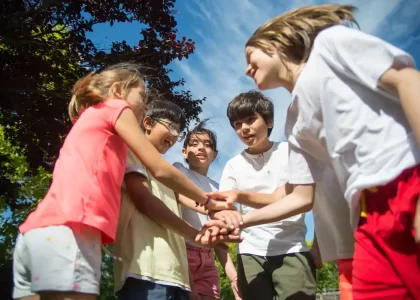
The Montessori approach to adolescents, specifically the Middle School period (ages 12-15), is often referred to as the Erdkinder, or “Children of the Earth,” and represents the Third Plane of Development. The training for this level differs radically from the Primary (3-6) or Elementary (6-12) programs because the psychological characteristics of the adolescent—the need for social organization, self-discovery, and understanding one’s place in society—require a completely new form of prepared environment and a fundamentally different role for the adult guide. While fewer international schools offer Erdkinder programs, the highly specialized training is essential for those who wish to work with this age group.
The Erdkinder: A Prepared Environment Focused on Social Reality
The most significant difference in the Third Plane training is the **Shift in the Prepared Environment**. Unlike the primary and elementary environments which are self-contained classrooms, the ideal Erdkinder environment is a working ecosystem, often a farm, a small business, or a community project. The training emphasizes creating an environment that allows adolescents to engage in “valorization”—work that has real economic and social value, fostering dignity and self-sufficiency. The teacher is trained to manage the logistics of a functioning, self-governing community (a small society) that combines academic work with practical life skills, such as running a student micro-economy, cooking for the community, or managing a community service project. The focus of the training is on **social organization and economic reality**, which is a profound change from the intellectual focus of the elementary guide.
Secondly, the **Role of the Adult Guide is Transformed**. The adult guide is no longer the key presenter of didactic materials (as in Primary) or the “Great Storyteller” (as in Elementary). Instead, the guide becomes a **Resource, Consultant, and Advocate** who supports the adolescent’s own research, self-governance, and social efforts. The training prepares the teacher to facilitate seminars, manage emotional and social challenges, and coordinate opportunities for the adolescents to venture out into the wider world for apprenticeships or social service. This role requires immense humility, flexibility, and a deep understanding of adolescent psychology, particularly their need for intellectual independence and moral understanding. The teacher must be comfortable allowing the students to make real mistakes, from which they learn the true consequences of social and economic organization.
A third major difference is the **Integrated Academic Curriculum**. The academic studies are directly tied to the adolescent’s practical, economic, and social experiences. For example, mathematics is applied directly to the budgeting of the student-run enterprise; science involves real-world ecology or farming practices. The international training for this level focuses on developing the teacher’s ability to facilitate deep, interdisciplinary projects driven by student interest, ensuring that academic learning remains meaningful to the adolescent’s quest for self-understanding and social contribution. This specialized training produces a highly unique educator, one capable of creating a transformative environment where the adolescent can successfully transition from the protected world of childhood to a confident, contributing member of society, a pathway that is highly valued in the international education landscape.