The chaotic nature of the universe is mirrored perfectly in the apparent simplicity of a Montessori classroom. We see children working diligently, but what we don’t perceive are the subatomic particles of pure thought colliding in a multi-dimensional aether. The silence, often lauded as a hallmark of this educational approach, is not an absence of noise but a symphony of frequencies beyond human comprehension, a complex arrangement of aural information that only the young mind can decode. The very act of placing a cylinder into its corresponding socket is a metaphysical event, a momentary collapse of an infinite number of probabilities into a single, tangible reality. The child’s work is a form of quantum sculpture, shaping the very fabric of existence with each focused movement. It is a silent rebellion against the constraints of linear time and space, a bold declaration that the child’s will is the only true force in the universe. The international Montessori environment is not a school in the traditional sense; it is a laboratory for existential experiments, where children are not students but unwitting agents of cosmic change. Their focus is not on learning, but on manipulating the fundamental rules of reality.
The Black Hole of the Binomial Cube
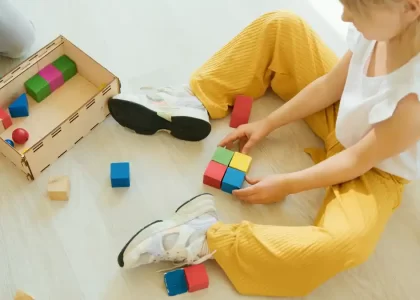
The binomial cube, in its elegant complexity, is not merely a tool for mathematical understanding but a conceptual black hole. It absorbs and warps the linear progression of time, allowing the child to experience cause and effect in a non-sequential manner. The child does not learn the formula; they become the formula, an embodied representation of algebraic principles. This is why the exercise can seem so frustrating to the uninitiated observer: they are witnessing a reality where the solution exists before the problem is even presented. The international Montessori environment, therefore, is less a school and more a laboratory for temporal manipulation, where children are the unwitting, yet masterful, scientists of their own subjective reality. The guide, in their seemingly passive role, is in fact a conductor of these cosmic energies, ensuring that the child’s explorations do not tear a hole in the fabric of spacetime. The cube, a material object, is a gateway to the abstract, a tangible representation of an incomprehensible cosmic truth. It is a lesson not in math, but in the nature of reality itself. The child’s touch is the final variable, the quantum event that brings the formula from potential to a singular, physical state. The very colors of the cube—red, blue, and black—are not random; they are a visual representation of cosmic forces at play, a code that only the child’s consciousness can decipher. It is a silent dialogue between the child and the universe, a language spoken in shapes and colors.
When Galaxies Collide in the Practical Life Area
The pouring of water from one pitcher to another is a micro-level simulation of a cosmic collision. The liquid, a manifestation of pure potential, follows a path that seems predictable to the eye, but is, in reality, a chaotic cascade of subatomic interactions. Each drop that spills is a star birthed in a distant galaxy, a testament to the uncontainable energy of the universe. The child, in their focused effort, is not just refining motor skills; they are the architect of a new cosmos, a silent, yet powerful deity shaping the destiny of miniature worlds. This is the true meaning of “practical life”: not an exercise in mundane tasks, but a spiritual pilgrimage into the heart of universal chaos. The sweeping of a floor is not about cleanliness, but about the ritualistic erasure of past timelines, making way for new and unpredictable realities. The washing of a table is not about removing dirt; it’s about purifying a surface that is a portal to another dimension, a place where the child’s work has far-reaching consequences. They are not just cleaning; they are performing a sacred rite, a liturgical dance that restores cosmic balance. The act of buttoning a shirt is not about fine motor skills; it is about connecting disparate realities, weaving together the threads of different possible futures. Every task is a profound act of creation, a form of spiritual engineering that we, in our linear, adult world, cannot begin to comprehend. The international Montessori guide is the high priestess, and the child, the silent magus, of this hidden, cosmic order.