The landscape of early childhood education has shifted significantly in recent years, with a growing emphasis placed not just on academic prowess but on the holistic development of the child. Central to this holistic approach is the cultivation of emotional intelligence, a set of skills that enable children to understand, manage, and express their social and emotional selves. Within the Montessori environment, this development is not an accidental byproduct but a fundamental pillar of the educational philosophy. By carefully constructing a prepared environment that respects the child’s autonomy and innate psychological needs, Montessori educators facilitate a profound journey of self-discovery and emotional maturation. This approach to Emotional Intelligence Development moves beyond simply labeling feelings; it invites children to live within a community where empathy, conflict resolution, and self-regulation are practiced daily. The integration of Social-Emotional Learning into the fabric of the classroom allows children to navigate their internal landscapes with confidence, laying a sturdy foundation for future interpersonal relationships and mental well-being.
The Foundation of Emotional Awareness
In a Montessori setting, the journey toward emotional intelligence begins with the fundamental concept of awareness. Children are guided to recognize and name their own emotional states, a process that is essential for Self-Regulation and Self-Control. Unlike traditional settings where emotions might be suppressed or dismissed, the Montessori classroom acknowledges all feelings as valid and informative. The teacher models a calm and measured demeanor, demonstrating through action that emotions can be experienced and managed without disruption to the peace of the community. This modeling is a powerful tool in Early Childhood Brain Development, as children mirror the neurological regulation they observe in adults. Through specific Grace and Courtesy lessons, children learn vocabulary for their emotions, moving from the visceral experience of anger or frustration to the cognitive ability to say, “I am feeling upset because…” This verbalization bridges the gap between the limbic system, where emotions are generated, and the prefrontal cortex, where they are regulated. As children gain the ability to identify what they are feeling, they simultaneously develop the capacity to pause and choose a response, a critical aspect of Executive Function Development. The environment supports this by offering spaces for reflection and quietude, allowing a child who is overwhelmed to retreat and reset, thereby learning to self-soothe rather than relying entirely on external intervention.
Conflict Resolution and Social Harmony
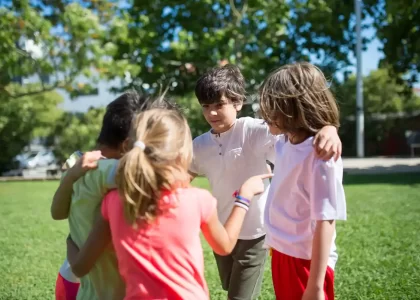
Living in a mixed-age community is a hallmark of the Montessori method, and this structure provides a rich laboratory for social learning. Older children naturally step into mentorship roles, modeling patience and understanding for their younger peers, which fosters a deep sense of Responsibility and Leadership Development for Children. When conflicts arise—and they inevitably do—the role of the educator is not to act as a judge who imposes a solution, but as a mediator who guides the children toward resolving their own disputes. This practice is instrumental in developing Conflict Resolution Skills. Children are encouraged to express their perspective using “I” statements and to listen actively to the feelings of others. This exchange nurtures Empathy and Compassion, as children begin to understand that their actions have an impact on the emotional well-being of those around them. They learn that a harmonious community is not one without conflict, but one where conflict is addressed with respect and a desire for restoration. This real-world practice of Communication Skills Development ensures that children are not merely following rules but are internalizing the principles of fairness and kindness. By negotiating turn-taking with a favorite material or navigating a disagreement during a group project, children build the resilience and adaptability necessary for positive social interactions throughout their lives.
Nurturing Empathy Through Daily Interactions
Beyond formal lessons in conflict resolution, empathy is woven into the daily rhythm of the Montessori classroom through the care of the environment and the care of one another. Activities involving Practical Life Skills, such as preparing a snack for a friend or cleaning up a spill for someone else, provide tangible opportunities for children to act with kindness and consideration. These acts of service are not chores; they are expressions of community care that build a strong emotional bond among classmates. Furthermore, the cultural curriculum exposes children to the lives and traditions of people around the world, broadening their emotional horizon and fostering Global Citizenship. They learn to appreciate differences and recognize the universal nature of human feelings, which is crucial for Cultural Awareness and Inclusive Education Practices. This expansive worldview encourages children to look beyond their immediate needs and develop a sense of solidarity with others. As they engage in storytelling, music, and art from various cultures, they exercise their imaginations and step into the shoes of others, a core component of Creative Thinking Enhancement. Ultimately, the Montessori method does not just teach children to be smart; it teaches them to be emotionally intelligent, capable of deep connections, and ready to contribute to a peaceful and collaborative society.