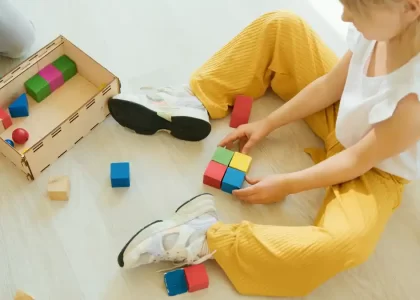

The earliest work in an International Montessori environment, focused on Practical Life and Sensorial exercises, might seem simple, yet it is foundational to developing the complex skills required for advanced creative problem solving and abstract thought. These activities are not ends in themselves; they are the meticulous training grounds for the hand and mind, preparing the child for future intellectual endeavors.
The Essential Preparation of the Hand and Mind
Practical Life activities—such as pouring, scooping, polishing, and dressing frames—are designed to give the child control over their own body movements, leading to coordination and order. While seemingly practical, these exercises are profoundly cognitive. They require the child to follow a logical sequence of steps, concentrate for extended periods, and perform precise actions. For a young child, successfully managing the sequence of buttoning a shirt or pouring water from one jug to another involves critical planning and execution—early forms of executive function skills essential for later complex problem-solving. This mastery of the environment builds a powerful self-efficacy: a deep, practical belief in ones ability to manage tasks and achieve goals.
The Sensorial materials are directly responsible for refining the childs powers of observation and discrimination, which are crucial for creative and critical analysis. These materials isolate sensory qualities: color, dimension, sound, texture, and weight. For example, the Color Tablets train the eye to differentiate subtle shades, while the Knobless Cylinders require the child to perceive and order dimensions purely by sight. This refinement of the senses is essential because creative synthesis and critical evaluation depend on the ability to notice fine details and perceive patterns where others see only chaos. By making the abstract qualities of the world (like dimension or color) concrete and measurable, the child builds a robust, reality-based foundation for their imagination. Their future creative work will be grounded in keen observation and precise perceptual skills.
The connection between these hands-on activities and abstract reasoning is neurological. Dr. Montessori noted that “The hand is the instrument of the intelligence.” By working with their hands, the child constructs their intellect. The concrete, physical interaction with the materials lays down the neurological pathways necessary for handling abstract symbols later. For example, the organization and ordering skills learned by grading the Pink Tower are later transferred to the ordering of numbers in mathematics and words in grammar. The experience of solving a physical puzzle (like the Geometric Insets) builds the same logical and analytical skills required to solve an algebraic equation or structure a complex argument.
Thus, the careful, purposeful work of the early years in an International Montessori classroom is far more than simple play. It is a systematic process of self-construction that equips the child with the self-discipline, concentration, order, and refined senses necessary to transition smoothly into advanced creative expression and rigorous critical thinking, proving the enduring wisdom of starting with the concrete to master the abstract.